Tipping in Germany: A Visitor's Etiquette Guide
June 5, 2026 • GermanNow • 6 minute read
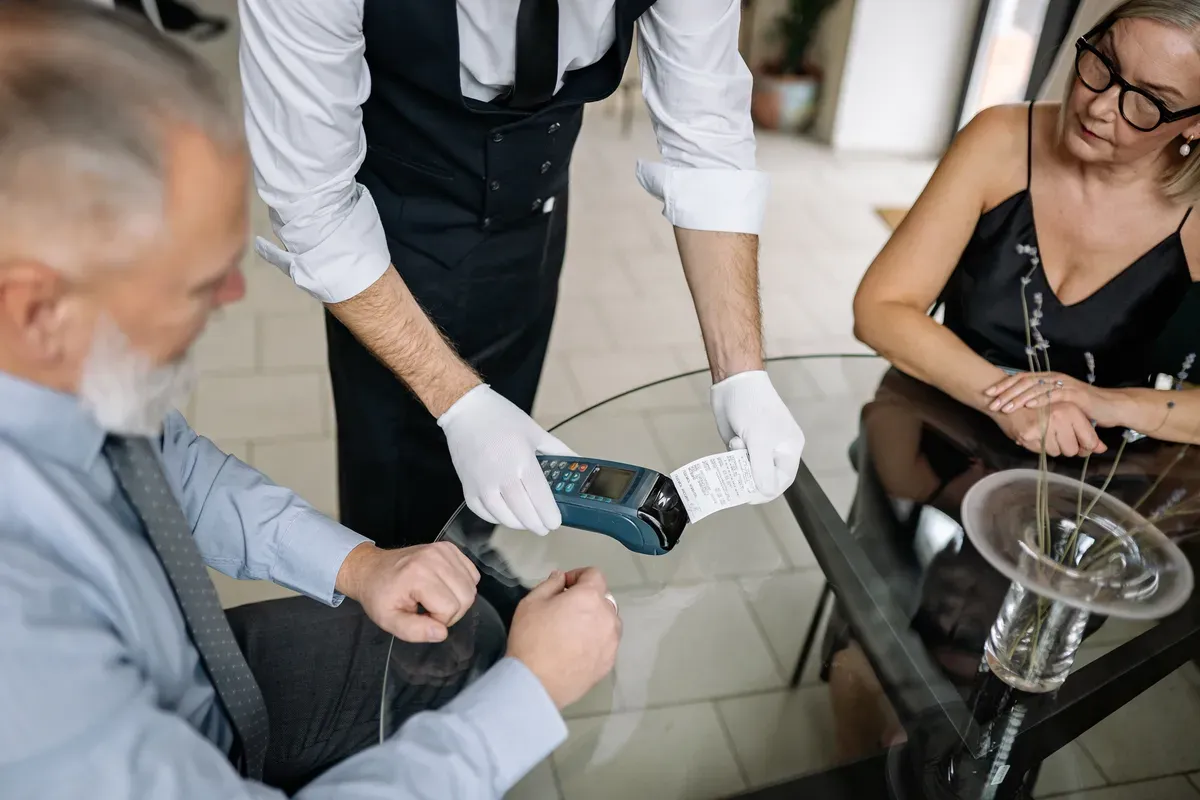
Table of Contents
- The one thing tourists get wrong
- How to tip in a German restaurant, step by step
- Asking for the bill
- ”Together or separate?”
- Stating your total
- How much to tip — and who
- Cards vs. cash: the practical trap
- Austria and Switzerland: what changes
- Greetings and politeness: Sie vs. du
- Your three-second cheat sheet
Picture it: the meal was great, the waiter is standing at your table, the card reader is already in their hand, and you have about three seconds to do the right thing. This is the exact moment where beginner German meets real life — and where most English-speaking visitors fumble, not because they tip the wrong amount, but because the whole mechanic is different from the US or UK. Get the words right and the transaction is effortless. Here’s how it actually works.
The one thing tourists get wrong
The single fact that trips up nearly every visitor: you don’t leave the tip on the table, and there’s usually no tip prompt on the card machine. Instead, you tell the server the total you want to pay, including the tip, and they make change or key in that figure.
Say nothing and pay the exact bill, and you’ve tipped nothing — even if you walk away feeling generous. The tip lives in a quick spoken exchange, not in coins left behind.
How to tip in a German restaurant, step by step
The whole ritual takes about fifteen seconds once you know the beats.
Asking for the bill
Catch the server’s eye and say zahlen, bitte (literally “to pay, please”) or the slightly more formal Rechnung version. Both mean “the bill, please.” German servers don’t drop the check unprompted — you ask for it.
”Together or separate?”
The server will often reply Zusammen oder getrennt? (“together or separate?”). Splitting the bill per person is completely normal in Germany, so don’t be shy. Answer zusammen, bitte (“together”) or getrennt, bitte (“separate”).
Stating your total
Now the key move. The server tells you the total — say, Das macht 16,30 Euro (“that comes to €16.30”). You then name the rounded-up figure you want to pay. Hand over a 20-euro note and say Machen Sie 18 (“make it 18”) to leave roughly a 10% tip and get €2 back. Or, if your change already lands near a round number, just say Stimmt so (“keep the change”) as you hand over the cash. That phrase uses the verb stimmen (“to be correct”) — stimmt so means “it’s right as is.”
| German | English | Who says it |
|---|---|---|
| Zahlen, bitte. | The bill, please. | you |
| Die Rechnung, bitte. | The bill, please (more formal). | you |
| Zusammen oder getrennt? | Together or separate? | server |
| Das macht 16,30 Euro. | That comes to €16.30. | server |
| Stimmt so. | Keep the change. | you |
| Machen Sie 18. | Make it 18. | you |
| Danke, stimmt so. | Thanks, keep the change. | you |
One detail that instantly marks a tourist: the decimal comma. Germans write and say 16,30 as “sechzehn dreißig,” never “sixteen point three zero.” If reading prices aloud feels shaky, our guide to German numbers 1–100 will get you comfortable fast.
How much to tip — and who
Tipping in Germany is freiwillig (voluntary). Service staff earn at least minimum wage, so a tip is a genuine thank-you, not a wage top-up. About 72% of Germans usually tip in restaurants, and nobody expects American-style 18–20%.
| Situation | Customary tip |
|---|---|
| Restaurant, table service | Round up + ~5–10% |
| Café or bar with table service | Round up, or ~10% |
| Counter service | Round up or coins in the jar (optional) |
| Larger / group bills | ~5% is plenty |
| Taxi | Round up to the nearest euro |
| Hairdresser | 5–10% |
| Hotel porter | €1–2 per bag |
| Hotel chambermaid | €2–3 per day, left in the room |
The percentage shrinks as the total grows — on a big group dinner, 5% is completely fine.

Enjoying this?
Travel phrases stick faster with daily reps. Grab our free PDF of the 100 most useful German words — sent by email, no spam.
Cards vs. cash: the practical trap
German card terminals historically have no tip prompt. That means you must state your tipped total before the server charges the card — say “Machen Sie 18,” then €18 goes through. If you wait for a gratuity screen, it won’t come.
Many Germans pay the bill by card but leave the tip in cash — a couple of coins handed straight to the server. It’s the frictionless option, which is why locals carry change. The takeaway for visitors: keep a few euro coins on you and tipping becomes a non-event.
Austria and Switzerland: what changes
The same core mechanic — state your rounded total to the server — works across all three countries, but the feel differs.
In Austria, bills are rarely itemized and tipping is felt as a little more expected; not tipping can read as quiet dissatisfaction. The amounts are similar (5–10%), and the common local phrase is Passt so instead of Stimmt so. Greetings shift too: you’ll hear Grüß Gott and Servus far more than the northern Guten Tag.
In Switzerland, service has been legally included in prices since 1974, so tipping is lighter — usually just rounding up to a convenient figure. Prices are in Swiss francs (CHF), not euros, and the local hello is Grüezi, with Hoi or Sali among friends.
Greetings and politeness: Sie vs. du
German social life runs on one distinction: Sie (formal “you,” always capitalized) versus du (informal “you”). As a visitor, the rule is simple — default to Sie with servers, shopkeepers, officials, and anyone you’ve just met. Over-formality is safe; over-familiarity can offend. The switch to du is a small social milestone, usually offered by the older or higher-status person, so don’t initiate it upward. If you want the full picture, see our deep dive on when to use du vs. Sie.
For everyday greetings, a few go a long way:
| German | English | When |
|---|---|---|
| Guten Tag | Good day / hello | neutral, daytime, safe anywhere |
| Hallo | Hi / hello | casual, widely fine |
| Auf Wiedersehen | Goodbye | formal farewell |
| Tschüss | Bye | casual farewell |
A warm hallo on the way in and a tschüss on the way out cover most casual encounters. And the single most multipurpose word you’ll lean on all trip is bitte — “please,” “you’re welcome,” and “here you go” all at once; just don’t use it to mean “keep the change” (that’s Stimmt so). If you want to master that little word, our guide to bitte breaks down every use.
Your three-second cheat sheet
When the waiter arrives and the card reader is out, you now know the script: ask with Zahlen, bitte, answer Zusammen oder getrennt?, and state your total with Stimmt so or Machen Sie 18. Round up 5–10%, keep some coins handy, and lead with danke and a friendly Sie. Try it on your very next coffee — the first time a server smiles and keys in your number, it’ll click for good. Viel Erfolg — you’ve got this.
Test your tipping etiquette
5 quick questions to see what stuck.
-
Complete the most useful tipping phrase — 'keep the change' in German: '___ so.'
Stimmt so literally means 'it's correct as is' — you say it as you hand over more than the bill.
-
Your bill is 16,30 €. You hand a 20 € note and want to tip about 10%. What do you say?
Machen Sie 18 tells the server to take €18 and return €2 — you state your total, not a separate tip.
-
In Germany, leaving a few coins on the table is the normal, expected way to tip.
You state your total to the server instead. Coins left on the table can be missed or read as careless.
-
Match each phrase to its job at the table.
Tap a German word, then its English meaning to pair them.
German
English
-
With a waiter you've never met, you should address them with Sie, not du.
Sie is the default for strangers and service staff. Wait to be invited before switching to du.
Related Articles



Keep going with German.
Get our starter pack of the 100 most common words — and the occasional new lesson when one's worth reading.